Glass Bead Game Becomes a Public Ritual
The Glass Bead GameGlass Bead Game Becomes a Public Ritual marks the change of the Glass Bead Game from a private practice into a public ceremonial institution. The transformation did not merely enlarge its audience: it joined a tightly governed symbolic language to contemplative discipline and collective observance, making a performance of intellectual relations into a festival that could represent unity across Castalia’s fields of learning.
From private exercise to public ceremony
For much of its history the Game could be played alone, in pairs, or among larger groups. Particularly brilliant and well-composed games might be written down and circulated between cities and countries for admiration or criticism, but this circulation did not yet make the practice a public institution. Players pursued it freely, as individuals or cliques, while ministries of education promoted it amiably.
The change came gradually: the Game acquired a public function alongside its private life. The contrast remained important. Young people and others could still play privately, but public ceremonial Games became what virtually everyone associated with the Glass Bead Game. In France and England the institution was organized first; other countries followed. Each established a Game Commission and a supreme official, the Ludi Magister, while official matches became cultural festivals conducted under that leader’s personal direction.
A regulated language and its guardians
The public ceremony rested on a specialized language rather than on free association. Its rules, signs, and grammar formed a highly developed symbolic system drawing especially on mathematics and music, through which the contents and conclusions of nearly all scholarly disciplines could be brought into relation. The Game could take as its starting point, for example, an astronomical configuration, a Bach fugue, or a sentence from Leibniz or the Upanishads. A player might elaborate that motif or extend it through allusions to related concepts.
Its vocabulary was not open to unrestricted expansion. The Ludi Magister supervised players and schools, but the further development of the Game was subject to higher collective control: the World Commission of the Magisters decided whether to admit new symbols and formulas, modify rules, or include new fields. Such additions had become rare. Each national Commission maintained an Archive registering the symbols and interpretations that had been examined and accepted; its contents had long since outnumbered the ancient Chinese ideographs. In this structure, public performance depended on prior training and institutional decisions about what counted as a legible, authorized sign.
Contemplation and collective discipline
Public ceremony also changed what counted as successful play. Before contemplation entered the Game, dazzling performances could be produced by mnemonists whose exceptional memories allowed them to marshal countless ideas rapidly, despite possessing no other virtues. Such displays dismayed and confused other participants. Over time, virtuosity of this kind came under increasingly strict prohibition, and contemplation became a central requirement.
After each symbol was introduced by the director, players were expected to meditate silently and formally on its content, origin, and meaning, calling its full significance to mind in an intensive and integrated way. The practice, cultivated in elite schools and carried into the Game by members of the Order and Game associations, was intended to keep its hieroglyphs from becoming empty signs. The emphasis thus shifted from speed of recollection and comprehension toward a deeper, more spiritual attention shared by the participants and, ultimately, expected of the audience.
The public Game as a festival
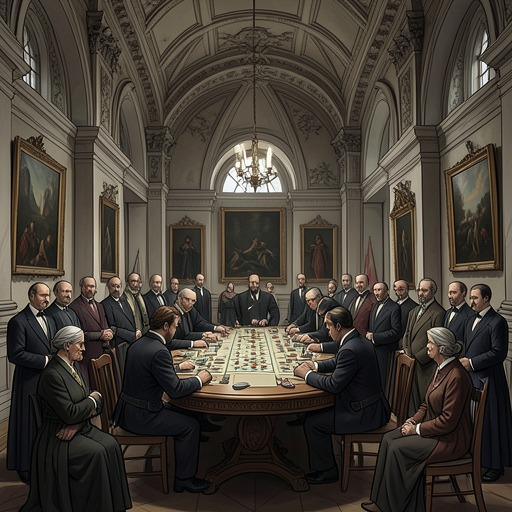
A few superior Masters, directly subordinate to the Ludi Magister of their country, led the public Games. Invited guests listened closely, while a wider audience followed events across the world. Official communication media, including radio, were made available only for the great matches over which the Ludi Magister personally presided. The anonymous status of the Magister extended the institution’s preference for impersonal office: apart from a few intimates, the public did not know the officeholder’s name.
Some ceremonial Games lasted days or weeks. During them, players and guests followed rules that even regulated how long they were allowed to sleep, living an ascetic and selfless life of complete absorption. The observance was compared to the strictly regulated penitence of participants in an exercise of St. Ignatius Loyola. At the spring annual festival, the Ludus anniversarius or sollemnis, the central solemn Game usually lasted ten days to two weeks. Though the earlier age of annual Games lasting weeks and attended by dignitaries from around the world had passed, this spring gathering remained Castalia’s great yearly festival.
Harmony, devotion, and institutional significance
The annual Game gathered tendencies that could otherwise remain divided, staging symbolic harmony among the Province’s disciplines. It checked their egotistic ambitions and recalled the unity that embraced their variety. For believers, the festival had the sacramental force of a true consecration; for unbelievers, it served at least as a substitute for religion. It offered both a solemn encounter with beauty. The account compares its shared consecratory force with the later rediscovery of Bach’s Passions: for some performers and listeners an act of worship, for others a religious substitute, and for all a solemn manifestation of art and creative spirit.
The public institution therefore depended on more than spectacle. Its authority came from the conjunction of a common symbolic grammar, trained interpretation, archival oversight, and shared contemplative discipline. The ceremony made those structures visible: individual players could create markedly different games even from the same limited set of themes, yet their work took place within a fixed and carefully guarded system. Public ritual turned that system into a collective event, giving the Game’s ideal of intellectual unity a ceremonial form.